
This manual provides an overview of basic concepts of residential pressure and air leakage testing, and provides steps for testing with Retrotec equipment.
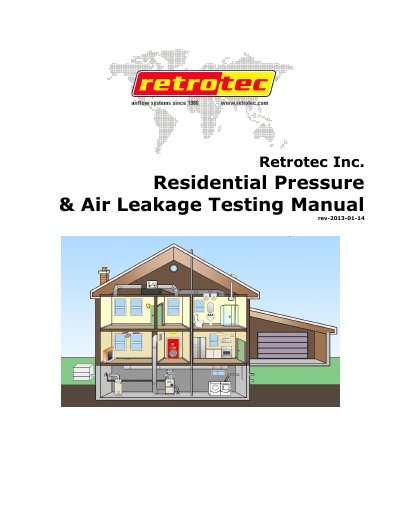
This manual provides instructions on how to measure air leakage in homes caused by stack pressure and wind effects. It details the components of a blower door system and explains how to reduce bias pressures and uncertainty in test results.
The document covers the full testing process, including preparing the building, selecting doorways, and recording site conditions like temperature and wind speed. It also describes methods for locating leaks using smoke, infrared cameras, and touch, as well as performing single-point and multi-point tests according to various standards.
Stack pressure is created by warm air rising or cold falling and is the major force in energy loss.
A Blower Door can be used to measure whole house leakage from any exterior doorway.
Houses typically experience common leak locations, including penetrations into the attic and where dissimilar building materials meet.