
This document describes the features and characteristics of the Agilent Refinery Gas Analyzer with application 383DH-00. It includes the ability to detect various compounds such as hydrogen and carbon dioxide using a thermal conductivity detector (TCD), as well as the ability to detect paraffins and olefins using a flame ionization detector (FID).
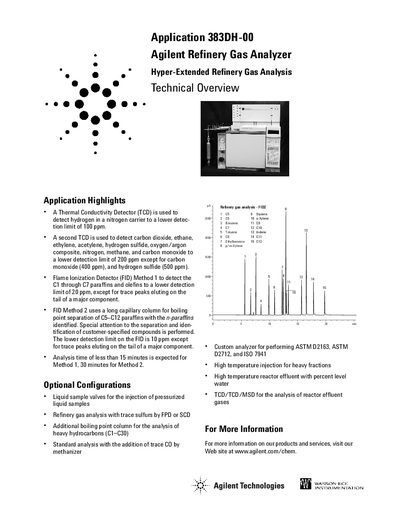
This document provides a technical overview of the Agilent 383DH-00 Hyper-Extended Refinery Gas Analyzer. It highlights the use of Thermal Conductivity Detectors (TCD) and Flame Ionization Detectors (FID) to detect specific gases and hydrocarbons with lower detection limits than standard analyzers. The analyzer supports various methods for detecting hydrogen, carbon dioxide, olefins, and paraffins, with analysis times of less than 15 minutes for Method 1 and 30 minutes for Method 2.
| Hydrogen detection limit | 100 ppm |
|---|---|
| Carbon monoxide detection limit | 400 ppm |
| Hydrogen sulfide detection limit | 500 ppm |
| C1 through C7 paraffins detection limit | 20 ppm |
| C5-C12 paraffins detection limit | 10 ppm |
| Method 1 analysis time | less than 15 minutes |
| Method 2 analysis time | 30 minutes |
The detection limit for hydrogen is 100 ppm.
The second TCD detects carbon dioxide, ethane, ethylene, acetylene, hydrogen sulfide, oxygen/argon composite, nitrogen, methane, and carbon monoxide.
The analysis time for FID Method 1 is expected to be less than 15 minutes.