
The document highlights the importance of proteome research in target identification for drug discovery, drug development, optimization of recombinant proteins, and diagnostic purposes. It explains that gene expression, gene sequence, and genome information alone are insufficient to understand protein dynamics and posttranslational modifications. The document also provides detailed information about the capillary HPLC separation of 2D in-gel digested protein spots, including experimental conditions and equipment.
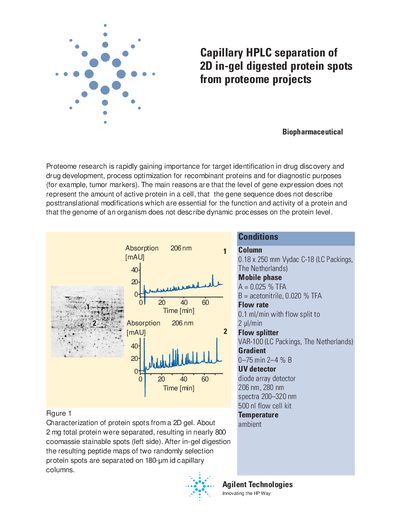
This document details the application of capillary HPLC for separating peptide maps derived from 2D in-gel digested protein spots, which is essential for proteome research when peptide amounts are at the femtomol level. It highlights the limitations of standard methods for such low quantities and presents capillary HPLC as the necessary solution.
| Column dimensions | 180-um id capillary columns |
|---|---|
| Flow rate (300-um id) | 4 ul per minute |
| Flow rate (180-um id) | 2 pl per minute |
| Starting flow rate | 100 pl per minute |
| Detection wavelength | 206nm, 280 nm |
Most protein spots are present in amounts only little above one picomol, but mainly at the femtomol level, requiring capillary HPLC for separation.
The Agilent 1100 Series system using the LC Packings flow splitting device is used to produce reproducible flow rates.