
MEMSIC MXD2020GL/ML is a high performance accelerometer produced by MEMSIC company. It has a resolution of better than 1 milli-g, digital outputs and good shock resistance. It can be applied to multiple fields such as automotive, security, information equipment, games, GPS, etc.
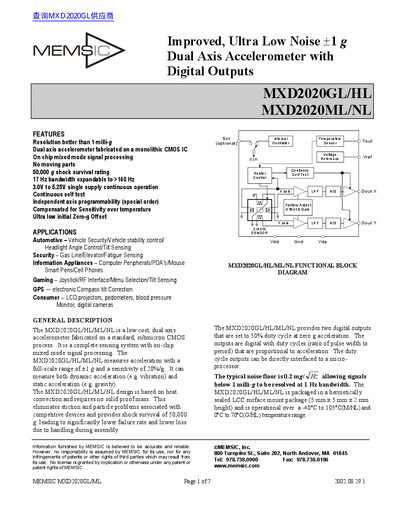
The MEMSIC MXD2020GL/HL/ML/NL is a low-cost, dual-axis accelerometer fabricated on a standard submicron CMOS process. It utilizes a unique design based on natural heat convection rather than solid proof mass, which eliminates stiction and particle problems while providing a high shock survival rating of 50,000 g.
The device provides two digital outputs with duty cycles proportional to acceleration, allowing for direct interfacing to microprocessors. It measures both dynamic and static acceleration with a full-scale range of +1 g and a sensitivity of 20% per g. The sensor is available in an LCC-8 surface mount package.
| Sensitivity | 20%/g |
|---|---|
| Shock Survival Rating | 50,000 g |
| Bandwidth | 17 Hz expandable to >160 Hz |
| Supply Voltage Range | 3.0V to 5.25V |
| Operating Temperature (M/NL) | -40°C to +105°C |
| Operating Temperature (G/HL) | 0°C to +70°C |
The device measures acceleration with a full-scale range of +1 g.
It operates based on heat transfer by natural convection using a gas proof mass instead of solid parts.
It provides two digital outputs set to 50% duty cycle at zero g acceleration.