
A direct conversion receiver architecture offers several advantages over the traditional superheterodyne. It eases the requirements for RF front end bandpass filtering, as it is not susceptible to signals at the image frequency. The RF bandpass filters need only attenuate strong out-of-band signals to prevent them from overloading the front end. Also, direct conversion eliminates the need for IF amplifiers and bandpass filters. Instead, the RF input signal is directly converted to baseband, where amplification and filtering are much less difficult. The overall complexity and parts count of the receiver are reduced as well. Direct conversion does, however, come with its own set of implementation issues. Since the receive LO signal is at the same frequency as the RF signal, it can easily radiate from the receive antenna and violate regulatory standards. Also, a thorough understanding of the impact of the IP2 and IP3 issues is required. These parameters are critical to the overall performance of the receiver and the key component is the I/Q demodulator. Unwanted baseband signals can be generated by 2nd order nonlinearity of the receiver. A tone at any frequency entering the receiver gives rise to a DC offset in the baseband circuits. Once generated, straightforward elimination of DC offset becomes very problematic. That is because the frequency response of the post-downconversion circuits must often e
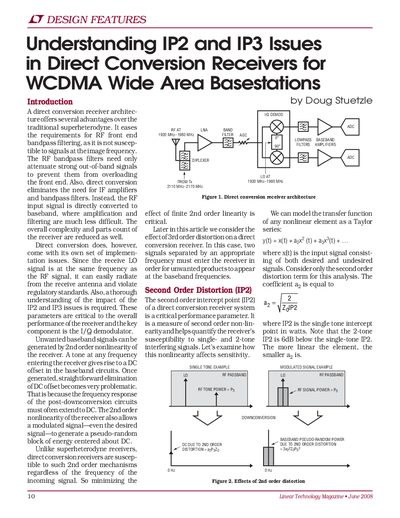
The document provides a technical analysis of implementation challenges in direct conversion receiver architectures, focusing on second-order nonlinearity and its impact on sensitivity. It details how unwanted baseband signals are generated by 2nd order mechanisms when single tones or modulated signals enter the system.
Specifically, the text uses the LT5575 I/Q demodulator as a representative example to calculate DC offsets and distortion power resulting from out-of-band tones and interfering WCDMA carriers. The analysis demonstrates that for typical basestation configurations, these second-order effects result in negligible degradation of receiver sensitivity.
It is a critical performance parameter that measures second-order nonlinearity and helps quantify the receiver's susceptibility to single- and 2-tone interfering signals.
The second order product created by an interfering WCDMA carrier is typically 17.5dB below the thermal noise at the receiver input, causing negligible degradation in sensitivity.