
This paper presents a charging management technique for Li-ion batteries. The technique uses a switching power path manager to minimize battery temperature rise during charging, thereby increasing charging speed.
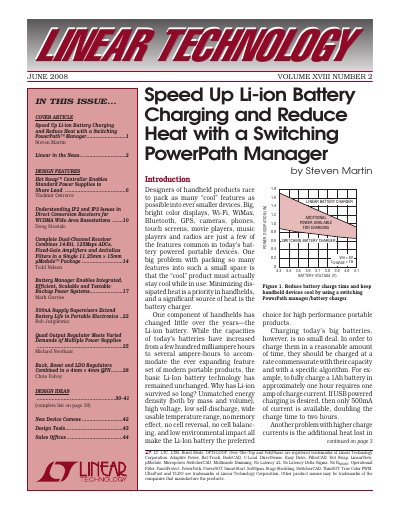
The document discusses the challenges of charging large Li-ion batteries in small, feature-rich portable devices, specifically addressing issues like long charge times when limited by USB current (500mA) and excessive heat generation. It highlights that while Li-ion technology remains standard due to its energy density and reliability, managing the thermal load during high-current charging is a priority for designers.
The article introduces the Switching PowerPath manager as a solution to these problems. By utilizing this component, designers can achieve faster charge rates commensurate with battery capacity while minimizing wasted heat, thereby keeping handheld devices cool during operation.
It helps minimize dissipated heat, which is a significant source of heat generated by the battery charger in portable products.
Only 500mA of current is available, which doubles the charge time for a 1Ah battery to two hours.
They offer unmatched energy density, high voltage, low self-discharge, a wide usable temperature range, and no memory effect.