
This document introduces the LTC3890 high-performance synchronous buck DC/DC controller, which can provide two output voltages ranging from 0.8V to 24V from an input voltage of 4V to 60V, and has high conversion efficiency and low static current. The device uses an integrated N-channel MOSFET driver and a current mode architecture to operate at a phase-lockable fixed frequency from 50kHz to 900kHz. The device has 99% duty cycle capability for low voltage dropout applications, adjustable soft-start or voltage tracking, and selectable continuous, pulse-skipping or Burst Mode operation, with a static current of only 50µA. These features, combined with the shortest on-time of just 95ns, make this controller an ideal choice for high step-down ratio applications.
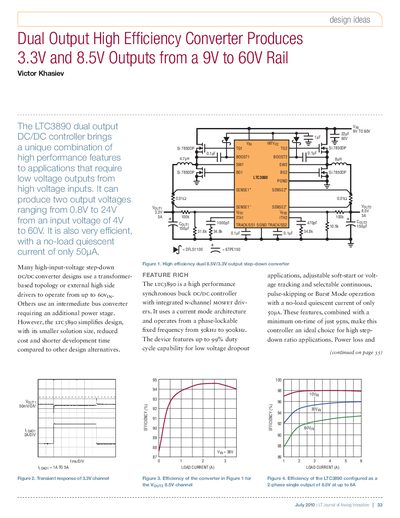
The LTC3890 is a dual-output DC/DC controller designed for applications requiring low voltage outputs from high voltage inputs, ranging from 4V to 60V. It features integrated N-channel MOSFET drivers and operates with a current mode architecture at frequencies between 50kHz and 900kHz.
The device operates from an input voltage ranging from 4V to 60V.
The controller has a no-load quiescent current of only 5µA.
Each output can be set to a voltage ranging up to 24V.