
This design note introduces a programmable baseband filter for software-defined UHF RFID readers. The filter uses a high-linearity direct conversion receiver to achieve reliable multitag detection and high data throughput. The filter's bandwidth can be programmed from 15 kHz to 150 kHz to meet the needs of various applications.
This document describes the application of the LTC6602 dual, matched, programmable bandpass filter in software-defined UHF RFID reader systems. The device features two identical filter channels with matched gain control and frequency-controlled lowpass and highpass networks to optimize tag signal detection.
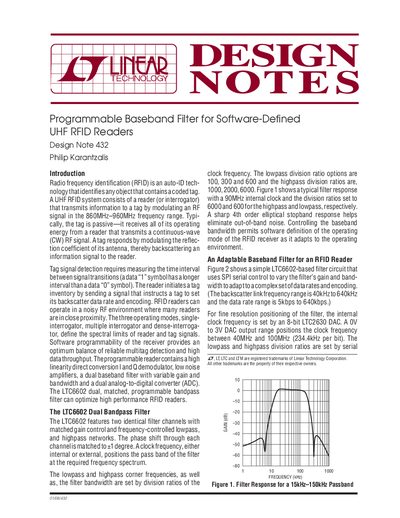
The note details how a clock frequency positions the passband at the required spectrum, while division ratios set by SPI control determine the lowpass and highpass corner frequencies. This allows for software definition of the operating mode to adapt to noisy RF environments with multiple interrogators.
The LTC6602 is a dual, matched, programmable bandpass filter that can optimize high performance RFID readers.
The available lowpass division ratios for setting corner frequencies and bandwidth are 100, 300, and 600.
A 0V to 3V DAC output range positions the internal clock frequency between 40MHz and 100MHz.