
Supercapacitors (or ultracapacitors) are increasingly being used in applications that require short-term energy storage and intermittent high-energy pulses. This document introduces a power ride-through circuit application where a backup energy source switches in and powers the load during a short power supply failure. This application has traditionally been dominated by batteries, but electric double layer capacitors (EDLCs) are gaining traction due to their decreasing price-per-farad, size, and effective series resistance per capacitance (ESR/C).
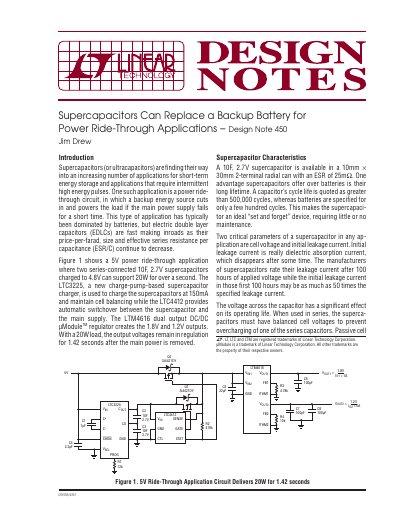
This document details an application where supercapacitors are used as a backup energy source for short-term power interruptions, replacing traditional batteries. The design utilizes two series-connected 10F, 2.7V supercapacitors charged to 4.8V to support a 20W load for over one second after the main supply fails.
The system employs the LTC3225 charge-pump-based charger to maintain cell balancing and charge the capacitors at up to 150mA, while the LTC4412 handles automatic switchover between the supercapacitor bank and the main supply. A dual output DC/DC regulator creates the final 1.8V and 1.2V outputs for the load.
| Charging Current | 150mA |
|---|---|
| Charge Voltage Options | 4.8V or 5.3V |
| Shutdown Load Current | <4μA |
| Leakage Load (Input Removed) | <1μA |
The output voltages remain in regulation for 1.42 seconds after the main power is removed.
The charger maintains a programmable charging current of up to 150mA.
A 2.5k balancing resistor is required to set the current based on worst case leakage.