
The document describes an automotive subminiature PCB power relay with a continuous current capacity of 15 amps and a maximum switching capacity of 60 amps. It offers four different contact materials and six different contact forms, designed for high inrush applications. The relay meets UL Class F insulation standard and is available with a dust cover or sealed version.
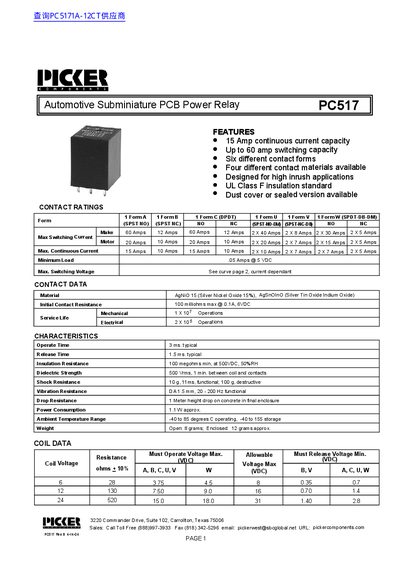
The PC517 is an automotive subminiature PCB power relay offered by Picker. It features a 15 A continuous current rating, up to 60 A switching capacity, and six contact forms with various materials. The relay is designed for high inrush applications and meets UL Class F insulation standards.
Technical details include a typical operate time of 3 ms, release time of 1.5 ms, insulation resistance of 100 MΩ at 500 VDC, and power consumption of about 1.1 W. It operates from –40 °C to 85 °C (storage to –40 °C to 155 °C) and weighs 8 g (open) or 12 g (enclosed).
| Continuous Current | 15 A |
|---|---|
| Switching Capacity | Up to 60 A |
| Operate Time | 3 ms typical |
| Release Time | 1.5 ms typical |
| Power Consumption | 1.1 W approx. |
| Ambient Temperature (operating) | -40 °C to 85 °C |
| Weight (open) | 8 g |
| Weight (enclosed) | 12 g |
| Coil Voltage Options | 4 V, 12 V, 24 V |
The relay is rated for a continuous current of 15 A.
The PC517 is offered with coil voltages of 4 V, 12 V, and 24 V.
The typical operate time is 3 ms.