
The LTC ®3707 is a high performance dual step-down switching regulator controller that drives N-channel syn- chronous power MOSFET stages.
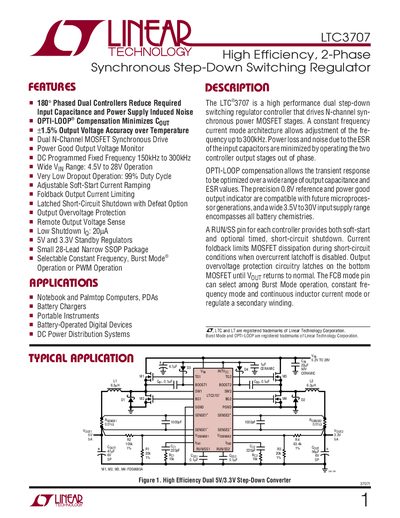
The LTC3707 controller drives two N‑channel synchronous MOSFETs to provide dual 5 V/3.3 V step‑down conversion. It features 180° phased dual controllers, low‑dropout operation, and programmable frequency from 150 kHz to 300 kHz. OPTI‑LOOP® compensation and a power‑good output monitor improve accuracy and stability.
Typical applications include notebook and palmtop computers, battery chargers, portable instruments, and DC power distribution systems. The device is supplied in a 28‑lead narrow SSOP package and includes pins for soft‑start, run control, current limiting, and remote voltage sensing.
| Input Voltage Range | 4.5 V to 28 V |
|---|---|
| Output Voltage Options | 5 V and 3.3 V standby regulators |
| Programmable Fixed Frequency | 150 kHz to 300 kHz |
| Maximum Duty Cycle (low dropout) | 99 % (typical 98 %–99.4 %) |
The LTC3707 operates with an input voltage from 4.5 V up to 28 V.
The device allows a fixed switching frequency between 150 kHz and 300 kHz.
It provides regulated 5 V and 3.3 V standby outputs.
The LTC3707 is supplied in a 28‑lead narrow SSOP package.