
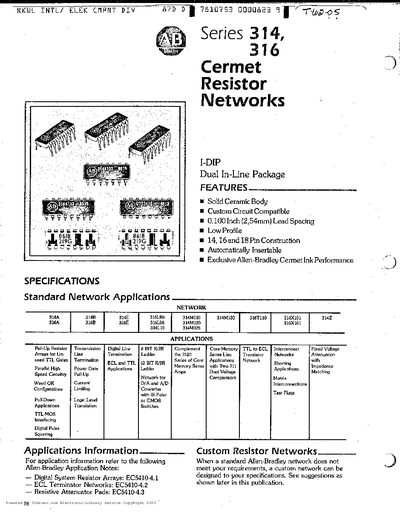
The Allen‑Bradley Series 314 and 316 cermet resistor networks are offered in dual‑in‑line packages with 14, 16 or 18 pins and a low‑profile design. They feature a solid ceramic body, custom circuit compatibility, and exclusive Allen‑Bradley cermet ink performance.
The document provides detailed specifications such as resistor tolerance, temperature coefficient, operating temperature range, power dissipation, and standard resistance values, along with application notes for pull‑up, pull‑down, TTL‑MOS interfacing, and line termination.
| Resistor tolerance | +2% (optional +1%) |
|---|---|
| Temperature coefficient of resistance | +100ppm/°C |
| Operating temperature range | -55°C to +125°C |
| Power dissipation rating | Up to 70°C ambient |
The resistor tolerance is +2%, with an optional tighter tolerance of +1% for certain values.
The temperature coefficient of resistance is +100 ppm/°C.
They operate from –55 °C up to +125 °C.
Power dissipation is rated up to 70 °C ambient temperature.