
This paper presents a technique for maximum power point tracking (MPPT) of a concentrating photovoltaic system using cell level power optimization. It solves the tradeoff between tracking speed and accuracy of the maximum power delivered in the traditional perturb and observe algorithm. The technique is suitable for rapid environmental condition changes, such as partial shading and self-shading.
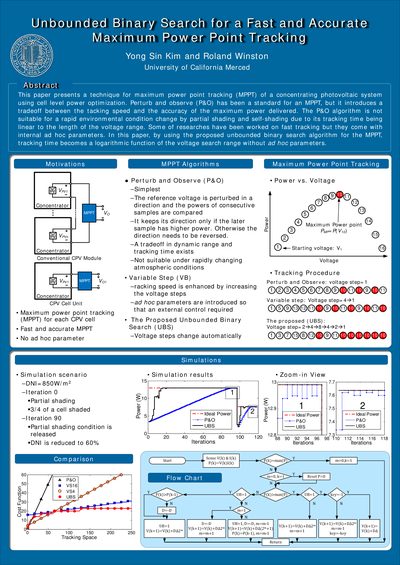
The paper introduces an unbounded binary search (UBS) algorithm for maximum power point tracking (MPPT) of concentrating photovoltaic (CPV) systems. It argues that traditional Perturb‑and‑Observe (P&QO) methods trade off tracking speed against accuracy and struggle under rapid shading changes.
Simulation results compare P&QO, a variable‑step method, and the proposed UBS, showing that UBS achieves logarithmic tracking time without any ad‑hoc parameters, automatically adjusting voltage steps for fast and accurate MPPT.
It proposes an unbounded binary search algorithm for MPPT that makes tracking time logarithmic and eliminates the need for ad‑hoc parameters.