
HDIB-C15 series DC current transducer is a measurement module that converts the measured DC current into a proportionally output DC current or DC voltage using the Hall effect and open loop measurement principle. The primary and secondary sides are highly insulated. It has the characteristics of high accuracy, high linearity, high integration, small size, simple structure, long-term stable operation and adaptability to various working environments. It is widely used in electrical equipment system control and testing in electric power, petroleum, coal mining, chemical industry, railway, communication, building automation and other industries.
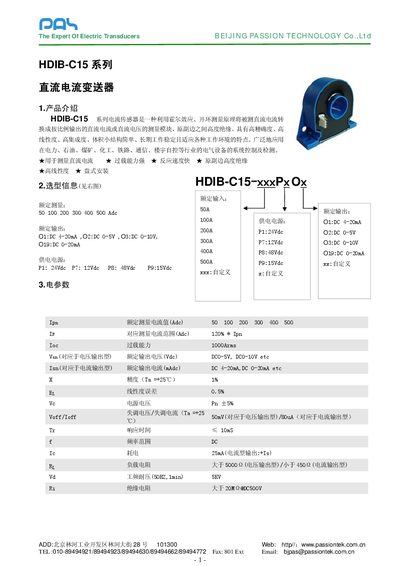
The HDIB-C15 series is a compact, high‑linearity Hall‑effect current transmitter designed for measuring DC currents up to 500 A. It offers multiple output options (4‑20 mA, 0‑5 V, 0‑10 V) and features high accuracy, strong overload capacity, and robust insulation suitable for industrial environments such as power, petrochemical, and railway systems.
The document includes product introduction, selection guidance, detailed electrical parameters, mechanical drawings, wiring diagrams, output characteristic curves, and safety instructions. It also lists the manufacturer’s contact information and compliance standards. This manual is written in Chinese.
| Rated measurement current | 50 A – 500 A |
|---|---|
| Output voltage (voltage‑type) | DC 0‑5 V, DC 0‑10 V |
| Output current (current‑type) | DC 4‑20 mA, DC 0‑20 mA |
| Linearity error | ±0.5 % |
| Overload capacity | 1000 A rms |
| Response time | ≈10 ms |
| Power consumption (current‑type output) | 25 mA |
| Operating temperature range | -25 °C to +70 °C |
| Storage temperature range | -40 °C to +185 °C |
| Weight | ≈100 g |
| Insulation resistance | >20 MΩ @ DC 500 V |
| AC voltage withstand (50 Hz) | 5 kV |
| Load resistance (voltage‑type output) | >5 kΩ |
The HDIB-C15 series can measure DC currents from 50 A up to 500 A.
It offers three output types: 4‑20 mA current output, 0‑5 V DC voltage output, and 0‑10 V DC voltage output.
The device has a linearity error of ±0.5 %.
Ensure no exposed conductive parts, avoid ESD, use qualified engineers for wiring, connect power, input and output wires correctly, and never reverse polarity.