
This document describes the features and characteristics of the 256-position, one-time programmable, dual-channel, I2C digital potentiometers AD5172/AD5173.
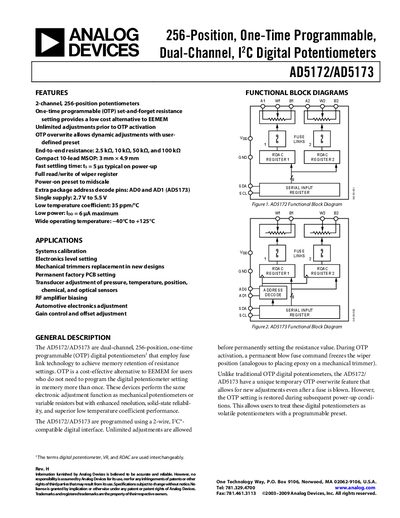
The AD5172/AD5173 are dual‑channel, 256‑position digital potentiometers that use fuse‑link technology for one‑time programmable (OTP) resistance settings. They operate over a single supply of 2.7 V to 5.5 V and support I²C‑compatible two‑wire serial communication. Features include fast 5 µs settling time, low temperature coefficient (35 ppm/°C), and optional OTP overwrite for temporary adjustments.
Typical applications are systems calibration, electronic level setting, replacement of mechanical trimmers, and sensor transducer adjustments in automotive and industrial electronics. The devices offer four end‑to‑end resistance options (2.5 kΩ, 10 kΩ, 50 kΩ, 100 kΩ) and provide full read/write access to the wiper register.
| Channels | 2 |
|---|---|
| Positions | 256 |
| Resistance range | 2.5 kΩ, 10 kΩ, 50 kΩ, 100 kΩ |
| Supply voltage range | 2.7 V to 5.5 V |
| Temperature coefficient | 35 ppm/°C |
| Settling time | 5 µs typical on power‑up |
The devices operate from a single supply of 2.7 V to 5.5 V.
Each part offers 256 discrete positions.
Yes, the OTP overwrite feature allows dynamic adjustments with a user‑defined preset even after the fuse is blown.
The I²C interface supports a clock frequency up to 400 kHz.