
This document introduces the models, supply voltage, working temperature, light source wavelength, output range, detection range, light source color, response time, housing material, protection level, connection cable, accessories, options of IRS-U-2A, IRS-U-4A, IRS-U-10RA, IRD-2A, IRD-4A and IRD-10RA.
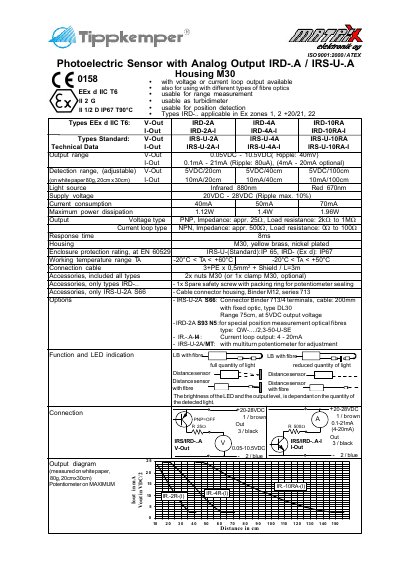
The IRD‑2A and IRS‑U‑2A series are photoelectric sensors with analog voltage (V‑Out) or current loop (I‑Out) outputs. They feature M30 yellow‑brass housings with nickel plating, IP67 (Ex d) or IP65 (Standard) protection ratings, and operate from 20 VDC to 28 VDC. Output ranges are 0.05 VDC‑10.5 VDC for voltage mode and 0.1 mA‑21 mA for current mode, with detection ranges adjustable up to 100 cm.
Mounting must follow Ex‑zone prescriptions: cable terminations are performed outside hazardous zones, certified EEx housings are required, and protective earth must be solidly connected to the housing. The sensors comply with ATEX, EN, and IEC standards and are intended for use in hazardous environments such as chemical plants and oil‑gas facilities.
| Output range (V‑Out) | 0.05 VDC – 10.5 VDC |
|---|---|
| Output range (I‑Out) | 0.1 mA – 21 mA |
| Detection range (V‑Out) | 5 VDC / 20 cm (up to 100 cm) |
| Light source | Infrared 880 nm |
| Supply voltage | 20 VDC – 28 VDC |
| Current consumption | 40 mA |
| Housing | M30, yellow brass, nickel plated |
| Enclosure protection rating | IP67 (Ex d) |
| Working temperature range | -20 °C to +60 °C |
| Response time | 8 ms |
The IRD‑2A provides a voltage output ranging from 0.05 VDC to 10.5 VDC.
The IRD‑2A sensor is rated IP67 (Ex d) for use in hazardous zones.
They require a supply voltage between 20 VDC and 28 VDC.