
M-MLV Reverse Transcriptase is a RNA-dependent DNA polymerase that can synthesize the first strand of cDNA using RNA as a template in the presence of primers. M-MLV Reverse Transcriptase is a recombinant expression protein from Escherichia coli, and the gene is optimized based on the amino acid framework of wild-type M-MLV, removing the activity of ribonuclease H (RNase H), and improving the enzyme-template-primer binding affinity, having good sustained synthesis capacity and obtaining high-yield cDNA.
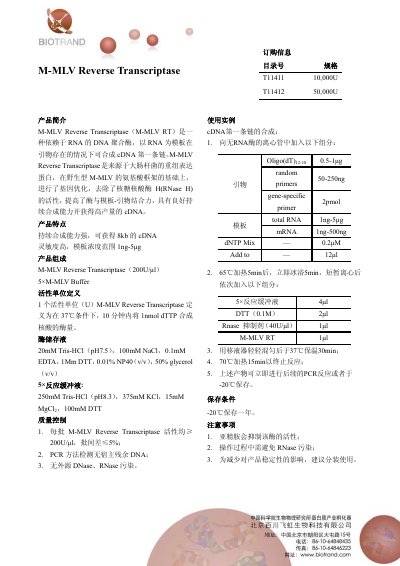
M-MLV Reverse Transcriptase (M‑MLV RT) is a recombinant DNA polymerase derived from *E. coli* that synthesizes the first cDNA strand from RNA templates in the presence of primers. The enzyme has been gene‑optimized to remove RNase H activity, providing strong continuous synthesis capability and high sensitivity, allowing up to 8 kb cDNA products from template concentrations of 1 ng–5 µg.
The leaflet lists the enzyme (200 U/µl) together with a 5× reaction buffer, storage solution composition, quality‑control criteria, and a step‑by‑step example protocol for first‑strand cDNA synthesis. It also includes storage recommendations (‑20 °C for up to one year), precautions against RNase contamination, and ordering information for two activity levels. This manual is written in Chinese.
| Enzyme activity | 200 U/µl |
|---|---|
| Maximum cDNA length | 8 kb |
| Template concentration range | 1 ng–5 µg |
| Storage temperature | -20 °C |
| 5× reaction buffer composition | 250 mM Tris‑HCl (pH 8.3), 375 mM KCl, 15 mM MgCl₂, 100 mM DTT |
One unit (U) is defined as the amount of enzyme that synthesizes 1 nmol of dTTP into nucleic acid in 10 minutes at 37 °C.
The enzyme should be stored at –20 °C and remains stable for up to one year.