
The document introduces a mouse anti-human granzyme B monoclonal antibody, which can be used for immunohistochemical staining of formalin-fixed paraffin-embedded or frozen sections, suitable for the detection of cytotoxic T cells.
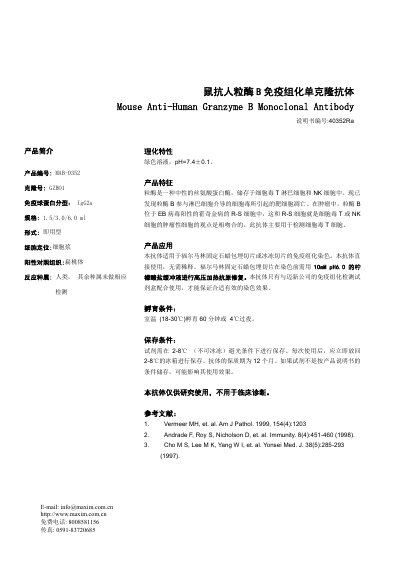
This manual describes the Maxim MAB-0352 mouse anti‑human Granzyme B monoclonal antibody, a ready‑to‑use (no dilution required) reagent for immunohistochemical staining of formalin‑fixed paraffin‑embedded or frozen tissue sections. The antibody targets human Granzyme B and is intended for research use only, particularly for detecting cytotoxic T‑cells and NK cells.
The document provides product specifications, storage and handling guidelines, incubation conditions, and references for further reading. It also notes that the antibody must be used together with Maxim's immunohistochemistry detection kit to achieve optimal staining results. This manual is written in Chinese.
| Product number | MAB-0352 |
|---|---|
| Clone | GZBO1 |
| Immunoglobulin type | IgG2a |
| Available volumes | 1.5 ml / 3.0 ml / 6.0 ml |
| pH | 7.4 ± 0.1 |
| Storage temperature | 2 °C – 8 °C (avoid freezing) |
| Shelf life | 12 months |
No, the antibody is supplied as a ready‑to‑use solution and can be applied directly.
Incubate at room temperature (18‑30 °C) for 60 minutes or at 4 °C overnight.
Store the antibody at 2‑8 °C, protected from light, and do not freeze.