
E0640r Rat Calmodulin(CAM) ELISA kit is used for quantitative measurement of CAM content in rat serum, plasma or other relevant biological fluids.
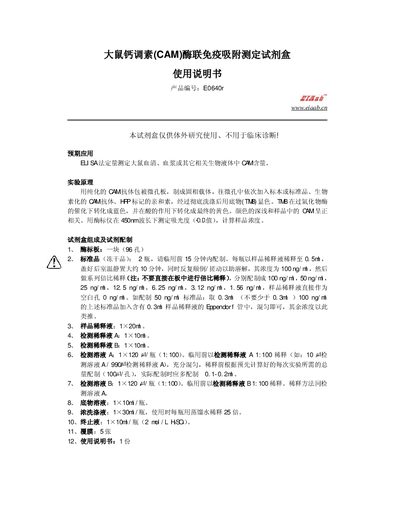
This kit is intended for in‑vitro research to quantitatively measure rat calmodulin (CAM) in serum, plasma or other related biological fluids using an ELISA method. The assay principle relies on purified CAM antibodies coated on a micro‑plate, followed by addition of sample, biotinylated antibody, HRP‑streptavidin and TMB substrate, with color development proportional to CAM concentration.
The kit includes a 96‑well plate, freeze‑dried standards, sample diluent, detection diluents A/B, detection solutions A/B, substrate solution, wash buffer, stop solution and sealing film. The manual details required equipment, sample collection and storage, reagent preparation, the complete assay procedure, plate washing methods, specificity, data calculation, detection range, and storage conditions. This manual is written in Chinese.
| Detection range | 1.56 ng/ml – 100 ng/ml |
|---|---|
| Lowest detection limit | 0.39 ng/ml |
| Shelf life | 6 months |
| Storage temperature | Standards and detection solutions at -20 °C; other reagents short‑term at 4 °C, long‑term at -20 °C |
The kit can quantify rat calmodulin (CAM) in serum, plasma, or other related biological fluids.
The assay detects CAM concentrations from 1.56 ng/ml up to 100 ng/ml.
Add at least 0.4 ml of wash buffer to each well, soak for 1–2 minutes, discard without touching the well walls, and tap dry.