
YL-72ZKG voltage regulator temperature controller is a temperature controller that uses single chip software control technology and is equipped with a dedicated solid-state relay. It has a power-off retention function and an analog output soft start function. It is especially suitable for temperature control in scenes such as bottle blowing machines, film blowing machines, plastic molding machines, extruders, sheet machines, and hot runners.
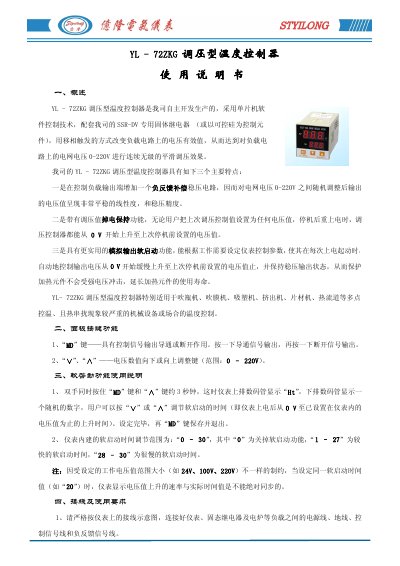
The YL‑72ZKG temperature controller is a self‑developed device that uses microcontroller software and an SSR‑DV solid‑state relay (or TRIAC) to continuously and smoothly adjust the load voltage from 0‑220 V. It features voltage‑feedback compensation for stable output, power‑off hold, and a programmable soft‑start function to protect heating elements.
The manual explains panel button functions, how to set and save soft‑start timing, wiring requirements, special precautions (such as matching phase lines and proper relay sizing), and provides single‑ and three‑phase wiring diagrams for installation. This manual is written in Chinese.
| Input voltage range | 0‑220 V |
|---|---|
| Soft‑start time adjustment range | 0‑30 |
| Required SSR‑DV relay current rating | 1.5‑2.5 × load current |
The relay’s current rating must be at least 1.5‑2.5 times the actual load current.
No, the controller is not suitable for inductive loads like induction furnaces or step‑down transformers.