
This is the instruction manual for the YEJ, YDEJ, YVPEJ series three-phase asynchronous motors of Ningbo Renovation Motor Factory. It mainly introduces the use environment, structure and working principle, installation, wiring and adjustment of the series motors.
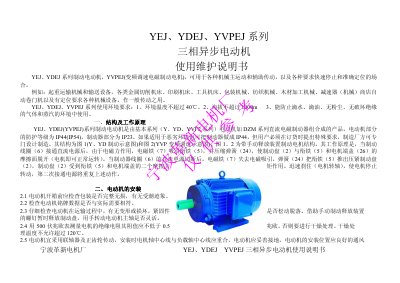
The guide describes the structure and working principle of the YEJ/YDEJ/YVPEJ series brake motors, including protection ratings (IP44 for the motor, IP23 for the brake) and environmental limits such as temperature ≤40 °C and altitude ≤1000 m. It details the motor’s basic components, the electromagnetic brake operation, and the optional IP44‑rated brake for harsh environments.
Installation steps cover unpacking, checking the nameplate, verifying insulation resistance (≥0.5 MΩ), proper coupling, grounding and ventilation. Subsequent sections explain wiring, brake adjustment (gap and torque), manual release device setup, rectifier replacement, normal operation, fault diagnosis and maintenance procedures, plus technical requirements and a parts list. This manual is written in Chinese.
| Motor protection rating | IP44 |
|---|---|
| Brake protection rating | IP23 |
| Maximum ambient temperature | 40 °C |
| Maximum service altitude | 1000 m |
| Minimum insulation resistance | 0.5 MΩ |
| Maximum bearing temperature | 95 °C |
| Brake working gap (DZM‑04) | 0.20–0.30 mm |
Loosen the fixing screw, insert a feeler gauge to measure the gap at several points, then tighten the screw until the measured gap falls within the specified working range (e.g., 0.20–0.30 mm for DZM‑04).
The insulation resistance must be at least 0.5 MΩ measured with a 500 V megohmmeter.