
The SC32 pump controller is an intelligent controller suitable for deep well pumps, submersible pumps, centrifugal pumps, and pipeline pumps. It has multiple protection functions, including overcurrent, phase loss, short circuit, undervoltage, overvoltage, and dry run protection. It can achieve level/pressure control and protection through wireless or wired methods. It can switch between 6 different automatic control modes using the control switch. It also features dual pump wireless control automatic rotation function and pump failure automatic switching function.
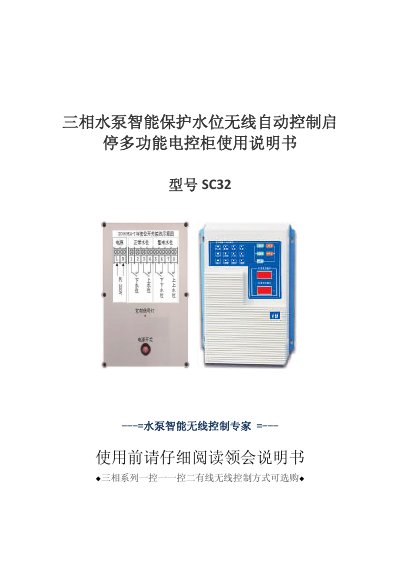
The SC32 series is a three‑phase water‑pump controller designed for deep‑well, sub‑mersible, centrifugal and pipe pumps. It offers overload, phase‑loss, short‑circuit, under‑voltage, over‑voltage and dry‑run protection, and supports both wired and wireless operation with up to six selectable automatic control modes.
The manual covers product overview, technical specifications, installation, wiring, configuration of overload and empty‑load settings, fault diagnosis, safety requirements and warranty information, helping installers and operators set up and maintain the system safely and efficiently. This manual is written in Chinese.
| Rated working voltage | AC380V/50Hz |
|---|---|
| Matched motor power | 0.37‑15 kW |
| Power consumption (max) | 5 W |
| Weight | ≈6.35 kg |
| Operating temperature range | -40 °C to +80 °C |
| Dimensions (L×W×H) | 24 cm × 16 cm × 9.5 cm |
| IP rating | IP65 |
| Wireless frequency range | 150 MHz – 5.8 GHz |
| Transmit power (selectable) | 0.1 W – 25 W |
| Receiver sensitivity | ≤ 0.25 µV |
Turn the controller on, let the pump run normally, note the operating current (A) and enter that value; the default factory setting is 4.0 kW (8.0 A) for a 4 kW pump.
Press the “Reset” key on the controller; this clears the fault indication and allows the affected pump (A or B) to restart.
The controller provides overload, phase‑loss, short‑circuit, under‑voltage, over‑voltage and dry‑run protection.
The unit can be switched among six different automatic control modes to suit various application scenarios.