
This kit uses a double antibody sandwich ELISA to measure the Hepc content in rat serum, plasma or other relevant biological fluids.
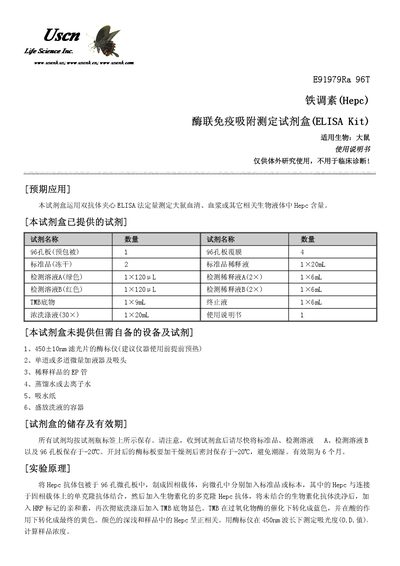
This manual provides detailed guidance for the Uscn Rat Hepcidin ELISA Kit, a double‑antibody sandwich ELISA designed to quantitatively measure Hepc in rat serum, plasma, or other biological fluids. It outlines the reagents supplied, those that must be prepared by the user, and the storage conditions required to maintain kit performance.
The document describes sample collection, reagent reconstitution, step‑by‑step assay procedures, and critical parameters such as detection range, limit of detection, and specificity. Safety warnings and troubleshooting tips are also included to help users obtain reliable results. This manual is written in Chinese.
| Detection range | 15.6 pg/mL – 1000 pg/mL |
|---|---|
| Limit of detection (LOD) | 7.5 pg/mL |
| Reagent storage temperature | -20 °C (standard) or -80 °C for long‑term |
| Kit shelf life | 6 months |
The kit can detect Hepc concentrations from 15.6 pg/mL up to 1000 pg/mL.
Serum or plasma should be centrifuged and the supernatant stored at –20 °C or –80 °C, avoiding repeated freeze‑thaw cycles.
The kit is guaranteed for six months from the date of receipt.
All reagents should be stored at –20 °C; opened plates should be sealed with desiccant and kept at the same temperature.