
This document is the instruction manual for the Rat Prolactin (PRL) ELISA Kit, which is intended for in vitro research use only and not for clinical diagnosis. It is used to quantitatively measure the prolactin levels in rat serum, plasma, or other related biological fluids using the ELISA method. The kit includes various reagents and their preparation methods, as well as the operational steps and requirements for sample collection and storage.
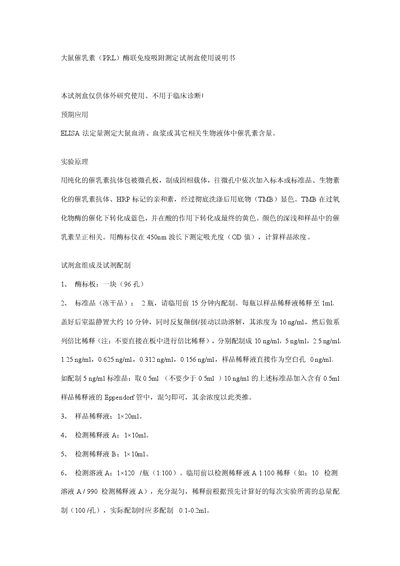
This manual describes the intended application of the rat prolactin (PRL) ELISA kit, which is to quantitatively measure prolactin levels in rat serum, plasma, or other related biological fluids using a standard ELISA protocol. The kit includes a 96‑well coated plate, standards, sample diluent, detection reagents, substrate and stop solution, and detailed steps for sample preparation, incubation, washing, and detection.
The procedure outlines sample collection and storage, preparation of reagents, plate loading, incubation times, washing steps, substrate development, and reading absorbance at 450 nm. It also provides guidance on data analysis, calculation of concentrations, detection range, and minimum detection limit, as well as storage and handling precautions. This manual is written in Chinese.
| Detection range | 0.156 ng/ml – 10 ng/ml |
|---|---|
| Minimum detection limit | 0.039 ng/ml |
| Plate format | 96‑well microtiter plate |
| Reading wavelength | 450 nm |
| Sample types | Serum, plasma, other biological fluids |
The assay can detect prolactin concentrations from 0.156 ng/ml up to 10 ng/ml.
Read the absorbance at 450 nm using a microplate reader.