
Rat FSH ELISA Kit User Manual, The kit can simultaneously detect natural or recombinant rat FSH, and has no cross-reactivity with other related proteins.
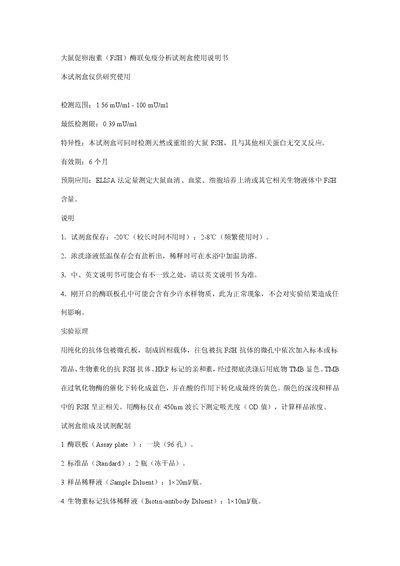
This manual provides detailed guidance for the rat FSH ELISA immunoassay kit, including the composition of the kit, storage conditions, and recommended equipment. It explains the principle of the assay, the preparation of standards and samples, and the step‑by‑step procedure for plate incubation, washing, substrate development, and termination.
Additional sections cover sample collection and preservation, dilution strategies for standards and samples, calculation of concentrations from absorbance readings, and important precautions to ensure reliable results. The document also lists optional equipment and supplies needed for the assay. This manual is written in Chinese.
| Minimum detection limit | 0.39 mU/ml |
|---|---|
| Specificity | No cross‑reaction with other related proteins |
| Shelf life | 6 months |
| Storage temperature | -20 °C for long‑term; 2‑8 °C for short‑term use |
Store the kit at –20 °C for long‑term storage, or at 2‑8 °C for short‑term use.
Collect whole blood, let it stand at room temperature for 2 h or at 4 °C overnight, centrifuge at 1000 g for 20 min, then use the supernatant or store at –20 °C/–80 °C, avoiding repeated freeze‑thaw cycles.
Measure the absorbance at 450 nm within 15 minutes after adding the stop solution.