
Rat estrogen (E) enzyme-linked immunosorbent assay kit instruction manual is for in vitro research and is not used for clinical diagnosis. The kit uses ELISA to quantitatively measure the estrogen content in rat serum, plasma or other related biological fluids.
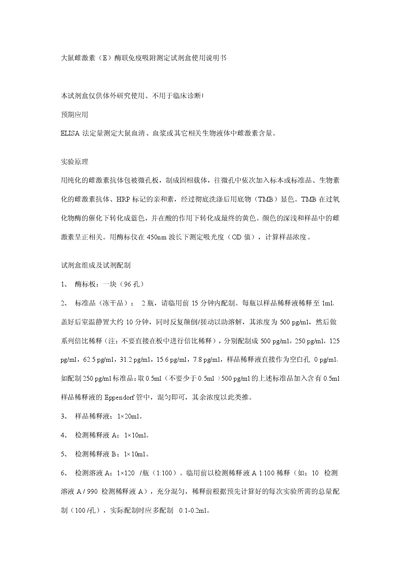
This manual describes the intended application of the Rat Estrogen ELISA kit, which is to quantitatively determine estrogen concentrations in rat samples for in‑vitro research. It lists all kit components, required reagents, and the preparation steps needed before starting the assay.
The document provides detailed procedures for sample collection, reagent preparation, plate incubation, washing, substrate development, and data calculation, including guidance on incubation times, temperatures, and how to interpret the optical density readings. This manual is written in Chinese.
| Detection range | 78 pg/ml – 500 pg/ml |
|---|---|
| Limit of detection | 3.9 pg/ml |
The kit can detect estrogen concentrations from 78 pg/ml up to 500 pg/ml.
Add 50 µl of stop solution to each well to terminate the reaction, which turns the color yellow.
Incubate the plate at 37 °C for the specified time (e.g., 2 hours for the first incubation).