
This document is the user manual for the Rat Glucagon-like peptide 1 (Glp-1) enzyme-linked immunosorbent assay (ELISA) kit. The kit is used for quantifying the level of Glp-1 in rat serum, plasma, cell culture supernatant, or other related biological fluids. The principle of the assay involves coating the microplate with purified Glp-1 antibody, adding the sample or standard, biotinylated Glp-1 antibody, and HRP-labeled avidin sequentially, followed by thorough washing and color development using TMB substrate. The intensity of the color is positively correlated with the concentration of Glp-1 in the sample, and the concentration is calculated by measuring the absorbance at 450nm using an ELISA reader.
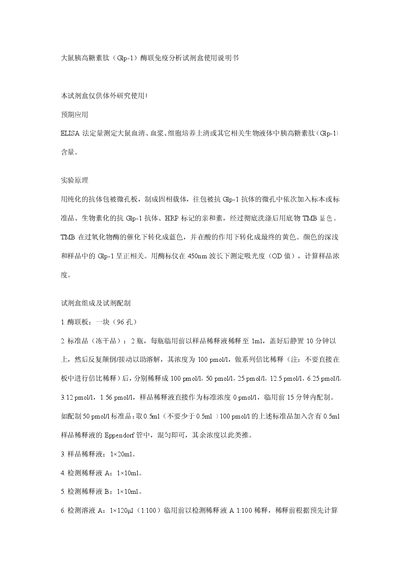
This manual describes the intended application of the rat GLP-1 ELISA kit, which is to quantitatively measure GLP-1 in various biological samples using a standard ELISA protocol. It lists all kit components, reagent preparation steps, and sample handling requirements.
Detailed assay procedures are provided, including plate coating, sample and standard addition, incubation times, washing steps, substrate development, and data acquisition at 450 nm. The document also covers calculation of concentrations, detection limits, storage conditions, and safety precautions to ensure reliable results. This manual is written in Chinese.
| Detection range | 1.56 pmol – 100 pmol per well |
|---|---|
| Limit of detection | 0.78 pmol per well |
| Shelf life | 6 months |
| Reagent storage temperature | Some reagents at -20 °C, others at 2‑8 °C |
The kit can detect GLP-1 concentrations from 1.56 pmol to 100 pmol per well.
The lowest limit of detection is 0.78 pmol per well.
Some reagents should be stored at -20 °C, while others should be kept at 2‑8 °C; always keep caps tightly closed to prevent evaporation and contamination.