
Instruction manual for mouse erythropoietin receptor (EPOR) enzyme linked immunosorbent assay kit
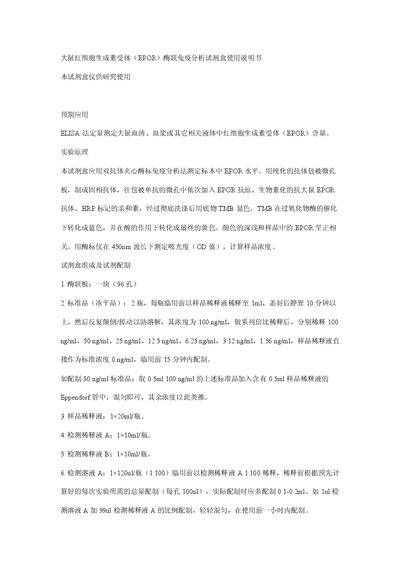
This manual describes the intended application of the rat erythropoietin receptor (EPOR) ELISA kit for quantitative measurement of EPOR in serum, plasma or other biological fluids. It outlines the composition of the kit, preparation of standards and reagents, and storage conditions for samples and reagents.
Detailed step‑by‑step procedures cover plate loading, incubation times, washing steps, substrate development, termination, and reading the absorbance at 450 nm. The document also provides guidance on plate washing methods, calculation of concentrations from the standard curve, and important precautions to ensure accurate results. This manual is written in Chinese.
| Plate format | 96‑well |
|---|---|
| Detection wavelength | 450 nm |
| Standard concentration | 100 ng/ml |
| Storage temperature (reagents) | -20 °C for some reagents, 2‑8 °C for others |
Read the absorbance at 450 nm using a plate reader.
Wash the plate 3 times after the first incubation and 5 times after the second incubation, each with 350 µl per well.
Store the substrate solution protected from light.
Prepare a series of dilutions from the 100 ng/ml standard to generate concentrations of 100, 50, 25, 12.5, 6.25, 3.12, 1.56 ng/ml and 0 ng/ml.