
This document provides instructions for the use and expected applications of the Rat Hydroxyproline (Hyp) ELISA Kit produced by USCN Life Science Inc. The kit is intended for in vitro research use only and is used to quantitatively measure the Hyp content in rat serum, plasma, or other related biological fluids.
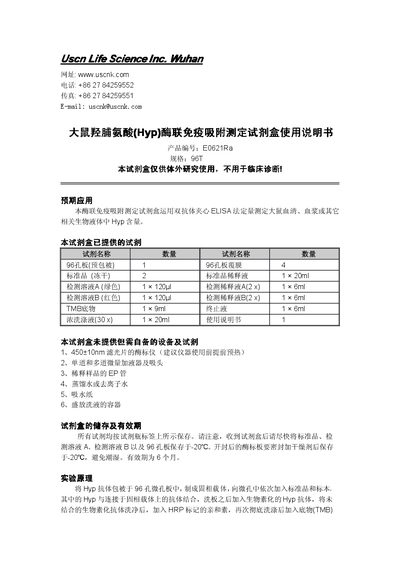
This manual provides detailed procedures for the rat hydroxyproline (Hyp) ELISA kit (product code E0621Ra) supplied by USCNK. It covers the principle of the assay, required reagents, sample preparation, step‑by‑step incubation, washing, and detection using a 450 nm filter.
The document also includes guidance on reagent storage, plate handling, data analysis, and safety precautions to ensure reliable quantitative measurement of Hyp in serum, plasma, or other biological fluids. This manual is written in Chinese.
| Detection range | 0.78 ng/mL – 50 ng/mL |
|---|---|
| Minimum detection limit | 0.21 ng/mL |
| Incubation temperature and time | 37 °C for 2 h |
| Plate format | 96‑well plate |
| Reagent storage temperature | -20 °C (sealed with desiccant) |
The assay can quantify hydroxyproline from 0.78 ng/mL up to 50 ng/mL.
Standard solutions, detection solutions A and B, and the 96‑well plate should be sealed and stored at –20 °C; sealed plates should include a desiccant.
Incubate the plate at 37 °C for 2 hours during the primary antibody binding step.