
This document provides instructions for the use of the Rat Ferrochelatase (FECH) Enzyme-linked Immunosorbent Assay (ELISA) Kit by Uscn Life Science Inc. Wuhan. The kit is intended for in vitro research and is not for clinical diagnosis. The document includes information on the kit components, storage and expiration date, experimental principle, collection and storage of samples, and preparation of reagents.
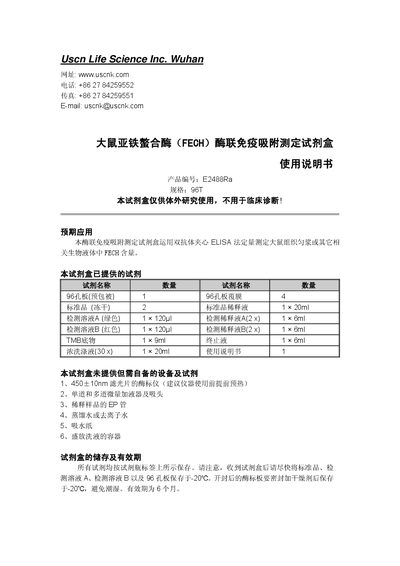
This manual provides detailed procedures for the rat ferrous chelate enzyme (FECH) ELISA kit (model E2488Ra). It describes the principle of the assay, required reagents, sample preparation, plate washing, and the step‑by‑step protocol for measuring FECH concentrations using a 96‑well plate.
Guidelines for reagent storage, plate handling, data calculation, and safety precautions are also included. The kit is intended for research use only and must be stored at -20 °C with desiccant to maintain stability. This manual is written in Chinese.
| Detection wavelength | 450 nm |
|---|---|
| Detection range (OD) | 0.001 – 3.000 OD |
| Minimum detection limit | 0.069 ng/mL |
| Standard curve concentrations | 20 ng/mL – 0 ng/mL (serial dilutions) |
The assay is read at 450 nm.
The minimum detection limit is 0.069 ng/mL.
Reagents and plates should be stored at –20 °C with desiccant and protected from moisture.
Incubate the plate at 37 °C for 15–25 minutes in the dark.