
This document provides instructions for the use of the Rat Thioredoxin Reductase (TrxR) Enzyme-Linked Immunosorbent Assay (ELISA) kit and explains the principle of the assay. It also includes information about the composition and preparation of the reagents. The kit is designed for the quantitative measurement of Thioredoxin Reductase (TrxR) levels in rat serum, plasma, cell culture supernatant, or other related fluids using the sandwich ELISA method.
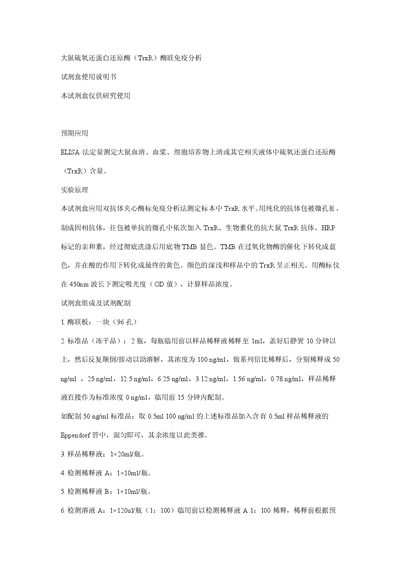
This manual provides step‑by‑step procedures for the rat thioredoxin reductase (TrxR) ELISA immunoassay kit, including preparation of standards, sample handling, incubation, washing, and color development. It also outlines storage conditions for reagents and samples to ensure reliable measurements.
Key sections cover the assay principle, reagent volumes, incubation times, washing steps, and reading the absorbance at 450 nm. Safety and troubleshooting tips are included to help maintain assay performance. This manual is written in Chinese.
| Detection Range | 0.78 ng/ml – 100 ng/ml |
|---|---|
| Reading Wavelength | 450 nm |
The absorbance should be measured at 450 nm.
Dilute the stock standard with the provided diluent to obtain a series of concentrations (e.g., 50 ng/ml, 23 ng/ml, 12.5 ng/ml, etc.) as described in the manual.
Store reagents at –20 °C or 2–8 °C as indicated for each component, and avoid repeated freeze‑thaw cycles.