
This kit is used to quantitatively measure the progesterone content in rat serum.
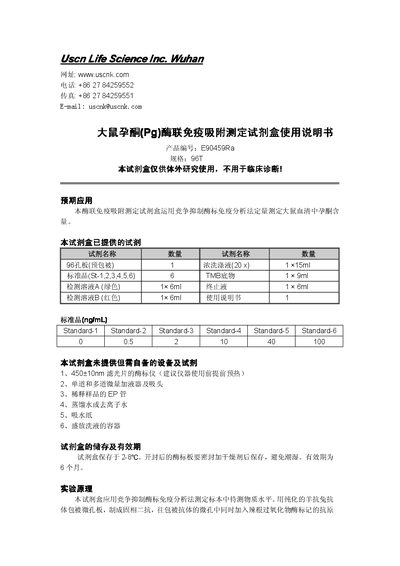
This manual provides detailed instructions for using the USCNK rat progesterone (Pg) ELISA kit, including the intended use, assay principle, and step‑by‑step procedures for sample preparation, plate incubation, washing, and detection. It also lists the required reagents, equipment, and safety precautions.
The document describes storage conditions for reagents and samples, plate washing methods (manual and automated), and how to calculate concentrations from optical density readings. It includes the detection range, minimum detection limit, and recommended wavelength for measurement. This manual is written in Chinese.
| Plate format | 96‑well |
|---|---|
| Detection range | 0.5 – 100 ng/mL |
| Minimum detection limit | 0.22 ng/mL |
| Standard concentrations | 0, 0.5, 2, 10, 40, 100 ng/mL |
| Reading wavelength | 450 ± 10 nm |
The assay can quantify progesterone concentrations from 0.5 ng/mL up to 100 ng/mL.
Reagents should be sealed and stored at 2‑8 °C for up to 48 hours, at –20 °C for up to 1 month, or at –80 °C for up to 2 months.
Read the plate at 450 nm (±10 nm) using a suitable filter.
Avoid contact with the sulfuric acid stop solution, wear protective clothing, and keep reagents away from eyes and skin.