
This assay kit is for research use only and is designed for the detection of rat bone alkaline phosphatase (BALP) using enzyme-linked immunosorbent assay (ELISA). The kit has high specificity and can simultaneously detect native or recombinant rat BALP without cross-reactivity with other related proteins. The detection range is from 15.6 U/L to 1000 U/L, with a minimum detection limit of 3.9 U/L. The kit has a shelf life of 6 months. It is intended for quantitative measurement of BALP levels in rat serum, plasma, cell culture supernatant, or other relevant biological fluids.
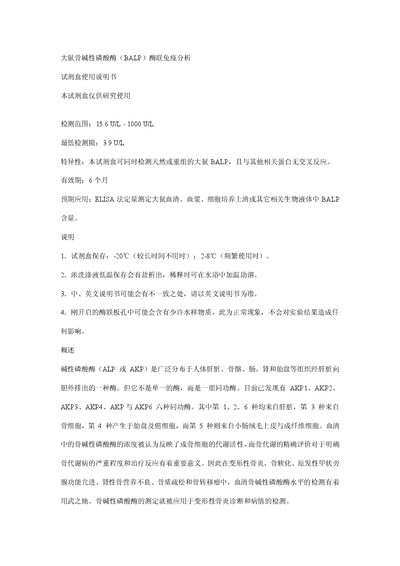
This manual describes the rat bone alkaline phosphatase (BALP) ELISA kit, its intended use for quantitative measurement of BALP in serum, plasma, cell culture supernatants and other biological fluids, and the required reagents and equipment. It includes storage conditions, preparation of standards and samples, and step‑by‑step assay instructions.
The document also provides guidance on washing the microplate, incubation times, detection at 450 nm, calculation of concentrations, and safety precautions. Proper handling and storage of reagents are emphasized to ensure reliable results. This manual is written in Chinese.
| Detection range | 15.6 UL – 1000 UL |
|---|---|
| Minimum detection limit | 3.9 UL |
Store the kit at –20 °C for long‑term storage and at 2–8 °C for short‑term use.
Serum, whole blood (processed), cell culture supernatants, and other biological fluids can be measured.
The absorbance is measured at 450 nm.