
This document describes the features and characteristics of the Rat GnRH Enzyme-Linked Immunosorbent Assay (ELISA) Kit, including the detection range, minimum detection limit, specificity, shelf life, and intended applications.
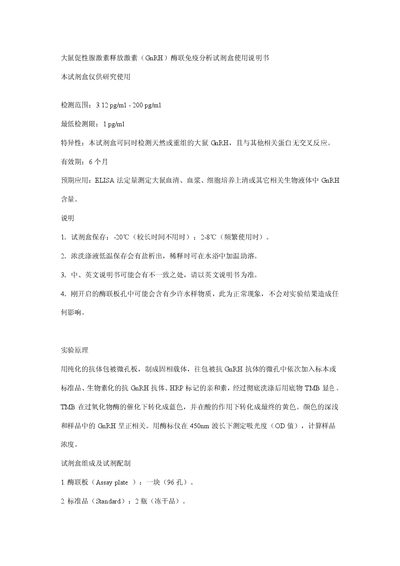
This manual provides detailed guidance for the rat Gonadotropin‑releasing hormone (GnRH) ELISA immunoassay kit. It describes the kit components, storage conditions, and preparation of reagents such as the assay plate, standards, sample diluent, biotin‑antibody, and HRP‑avidin solutions.
The document also outlines the complete assay workflow, including sample collection, dilution principles, plate washing, incubation steps, substrate development, termination, and optical density measurement. Additional sections cover calculation of sample concentrations, precautions, and recommended practices for reliable results. This manual is written in Chinese.
| Detection range | 3.12 pg/ml – 200 pg/ml |
|---|---|
| Minimum detection limit | 1 pg/ml |
| Shelf life | 6 months |
| Reagent storage (long term) | -20 °C |
| Reagent storage (frequent use) | 2‑8 °C |
The kit can detect GnRH concentrations from 3.12 pg/ml up to 200 pg/ml.
Store the kit at –20 °C for long‑term storage and at 2‑8 °C when used frequently.
The assay’s minimum detection limit is 1 pg/ml.
The kit has a shelf life of six months.