
This document provides instructions for using the Rat β-Endorphin (β-EP) Enzyme-Linked Immunosorbent Assay (ELISA) Kit, including information on storage, experimental principles, composition and preparation of the kit, as well as sample collection and storage.
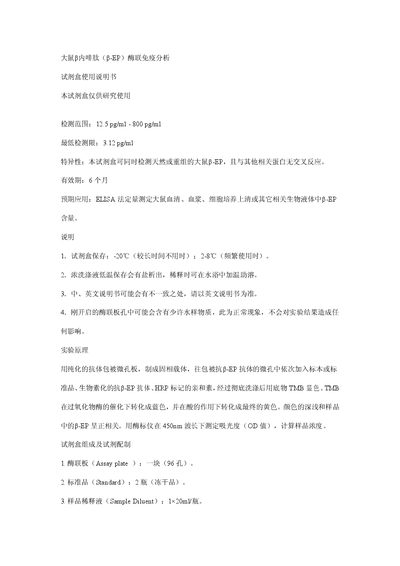
This manual describes the components of the rat β-Endorphin ELISA kit, storage conditions, and preparation of reagents. It provides detailed procedures for sample collection, dilution, plate loading, incubation, washing, substrate development, and termination, as well as guidance on using a plate reader at 450 nm.
Additional sections cover calculation of sample concentrations from standard curves, recommended precautions to avoid false positives, and optional manual or automated plate‑washing methods. The kit is intended for research use only and supports detection of rat β‑Endorphin in serum, plasma, cell culture supernatants, and other biological fluids. This manual is written in Chinese.
| Detection range | 12.5 pg/mL – 800 pg/mL |
|---|---|
| Minimum detection limit | 3.12 pg/mL |
| Specificity | Detects natural or recombinant rat β‑EP with no cross‑reaction to related proteins |
| Shelf life | 6 months |
| Storage temperature | -20 °C for long‑term; 2‑8 °C for short‑term use |
The kit can measure concentrations from 12.5 pg/mL up to 800 pg/mL.
The lowest detectable amount is 3.12 pg/mL.
Store the kit at –20 °C for long‑term storage, or at 2‑8 °C for short‑term use.
The kit has a shelf life of six months.