
XbaI endonuclease is a DNA endonuclease produced by Thermus aquaticus bacteria. It can recognize the T^CTAGA sequence and cleave the DNA double strand at its cleavage point. The basic information of this endonuclease is as follows: recognition sequence T^CTAGA, buffer compatibility 50-100%, enzyme cutting temperature 37℃, inactivation conditions 65℃, 20min, and methylation interference is sometimes interfered. According to the different neighboring sequence of the recognition sequence, the enzyme cutting effect is affected by dam methylase-induced DNA methylation. Enzyme storage solution consists of: 10 mM Tris-HCl (pH7.5 at 25℃), 100 mM KCl, 0.1 mM EDTA, 10 mM 2-mercaptoethanol, 0.2 mg/ml BSA and 50% glycerol. 1X Buffer Y consists of: 33 mM Tris-acetate (pH7.9 at 37℃), 10 mM magnesium acetate, 66 mM potassium acetate, and 0.1 mg/ml BSA. Enzyme cutting and connection efficiency: 50 times the excess of the present endonuclease digested for 1 hour, >95% of the fragments cut by the enzyme can be connected and re-cut (recut). The active unit is defined as 1 U, which is the amount of enzyme that completely decomposes 1 μg of λ DNA in a 37 °C, 50 μL reaction system for 1 hour.
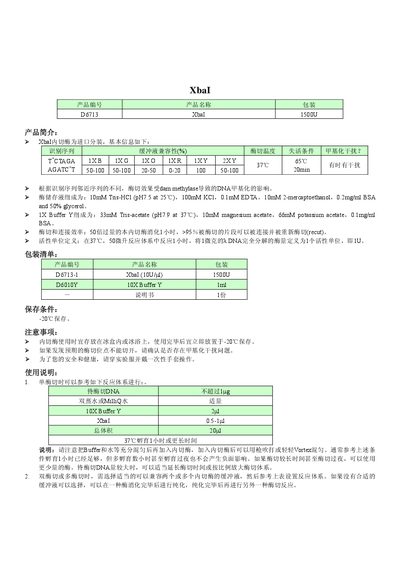
The document describes the XbaI restriction enzyme, its activity (1500 U per vial) and recommended reaction conditions. It includes detailed buffer formulations (10 mM Tris‑HCl pH 7.5, 100 mM KCl, 0.1 mM EDTA, 10 mM 2‑mercaptoethanol, 0.2 mg/ml BSA, glycerol) and a 1× working buffer (33 mM Tris‑acetate pH 7.9, 10 mM Mg‑acetate, 66 mM K‑acetate, 0.1 mg/ml BSA).
Instructions cover enzyme activation, DNA amount limits, incubation temperature (37 °C for 1 h), and storage (‑20 °C). Safety notes and troubleshooting tips are also provided. This manual is written in Chinese.
| Enzyme activity | 1500 U |
|---|---|
| Optimal digestion temperature | 37 °C |
| Maximum DNA input per reaction | 1 µg |
Incubate the reaction at 37 °C for about 1 hour.
The 10× Buffer Y contains 33 mM Tris‑acetate (pH 7.9 at 37 °C), 10 mM magnesium acetate, 66 mM potassium acetate, and 0.1 mg/ml BSA.