
This document provides instructions for using the OVA (Ovalbumin) enzyme-linked immunosorbent assay (ELISA) kit produced by USCN Life Science Inc. The kit is intended for in vitro research use only and is used to quantitatively measure the level of OVA in serum, plasma, tissue homogenates, cell culture supernatants, or other related biological fluids.
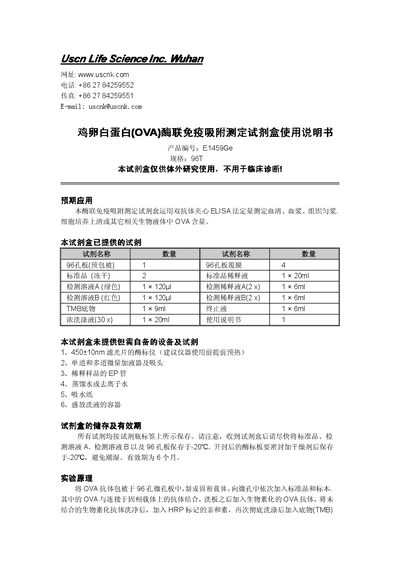
This manual describes the principle, reagents, and step‑by‑step procedure for the OVA ELISA kit. It covers sample collection, reagent preparation, plate incubation, washing, and color development using a 96‑well microplate.
Guidelines for storage of reagents, incubation conditions, and data calculation are provided, along with specifications such as detection range, detection limit, and measurement wavelength. This manual is written in Chinese.
| Plate type | 96‑well microplate |
|---|---|
| Detection range | 0.156 ng/mL – 10 ng/mL |
| Detection limit | 0.08 ng/mL |
| Incubation temperature | 37 °C |
| Reagent storage temperature | -20 °C |
| Wash buffer volume per well | ≥0.4 mL |
The minimum detectable concentration is 0.08 ng/mL.
Reagents should be stored at –20 °C; the plate should be sealed with desiccant and kept dry.
Incubate the plate at 37 °C for the specified time.