
The DCM series is a power converter developed by JNXpower, which supports -48 VDC input and complies with ETSI and NEBS standards. The series has high power density, small size, flexible cooling methods, etc. It is suitable for 1U network systems, switches, routers, system monitoring and video production racks.
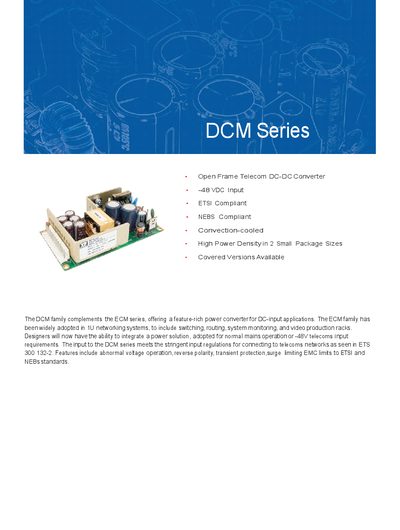
This document describes the DCM family of open‑frame telecom DC‑DC converters, covering both +48 VDC and -48 VDC input configurations. It includes detailed electrical specifications such as input/output voltage ranges, efficiency, switching frequency, and isolation ratings.
Mechanical drawings, thermal considerations, environmental limits, and safety agency approvals are also provided, along with EMC test results and service‑life estimations. The data sheet is intended for designers integrating the DCM modules into networking, routing, and video production equipment.
| Input Voltage | Configurable for +48 VDC or -48 VDC |
|---|---|
| Output Voltage | 12 VDC |
| Efficiency (full load) | 85 % |
| Switching Frequency | 70 kHz |
| Isolation (Input to Output) | 1500 VDC |
| Weight (DCM60) | 0.44 g |
The DCM series can be configured for either +48 VDC or -48 VDC input.
The DCM series achieves 85 % efficiency at full load.
The switching frequency is 70 kHz.