
This document provides instructions for the use of Rat Tissue Factor (TF) Enzyme-Linked Immunosorbent Assay (ELISA) Kit. The kit is intended for in vitro research use only and is used to quantitatively measure the TF content in rat plasma or other related biological fluids. The experimental principle involves the immobilization of purified TF antibodies on a microplate, followed by the addition of samples or standard substances, biotinylated TF antibodies, and HRP-labeled avidin. After thorough washing, the substrate (TMB) is added for color development. The intensity of the color is positively correlated with the TF content in the samples. The absorbance (OD value) is measured at a wavelength of 450nm using an ELISA reader to calculate the sample concentration.
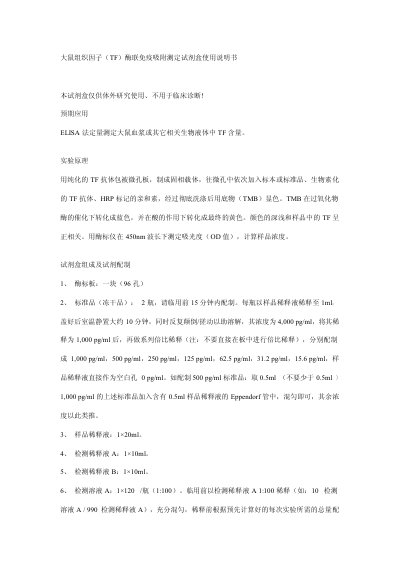
This manual describes the intended application of the rat tissue factor (TF) ELISA kit, the ELISA principle, and the composition of the kit, including the 96‑well plate, standards, reagents, and consumables. It also provides detailed steps for sample preparation, reagent handling, incubation, washing, substrate development, and data reading on a microplate reader.
Guidelines for specimen collection, storage conditions, and quality‑control measures are included, along with the assay detection range (15.6 pg/mL – 1,000 pg/mL), lowest detection limit (3.9 pg/mL), and recommended storage temperatures for reagents. This manual is written in Chinese.
| Detection range | 15.6 pg/mL – 1,000 pg/mL |
|---|---|
| Lowest detection limit | 3.9 pg/mL |
| Standard stock concentration | 4,000 pg/mL |
The kit can measure rat plasma or other related biological fluids such as serum, provided the samples are centrifuged and the supernatant is used.