
This kit is used for the quantitative determination of Salusin α in human serum, plasma or other relevant biological fluids.
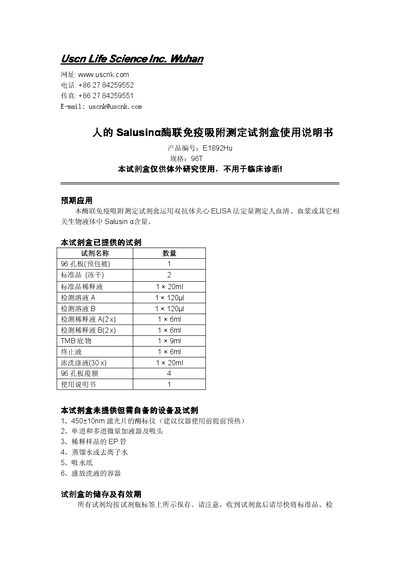
This manual provides step‑by‑step instructions for performing the Salusin ELISA assay, covering sample collection, reagent handling, plate preparation, incubation, washing, and detection. It also includes guidance on storage conditions for reagents and plates, as well as safety precautions.
The document details the assay principle, the preparation of standard curves, calculation of sample concentrations, and the limits of detection. It is intended for laboratory personnel conducting quantitative measurement of Salusin in serum, plasma, or other biological fluids. This manual is written in Chinese.
| Detection wavelength | 450 ± 10 nm |
|---|---|
| Limit of detection | 5.9 pg/mL |
| Standard curve range | 0.001 – 3.000 OD |
| Reagent storage temperature | -20 °C to -80 °C |
The assay is read at 450 nm using a 450 ± 10 nm filter.
Store all reagents and the 96‑well plate at –20 °C (or –80 °C for long‑term storage) and keep them dry to avoid moisture.
The minimum detectable concentration is 5.9 pg/mL.
The kit is guaranteed for six months from the date of manufacture.