
The LM2596 switch voltage regulator is a step-down type power management integrated circuit that can output 3A of drive current, with good linearity and load regulation characteristics. Fixed output versions are available in 3.3V, 5V, and 12V, and adjustable versions can output a variety of voltages between 1.2V and 37V. The device integrates frequency compensation and a fixed frequency oscillator with a switching frequency of 150KHz, which can use smaller filter components than low-frequency switching regulators. Since the device only requires 4 external components and can use a general standard inductor, it further optimizes the use of LM2596 and greatly simplifies the design of switch power supply circuits.
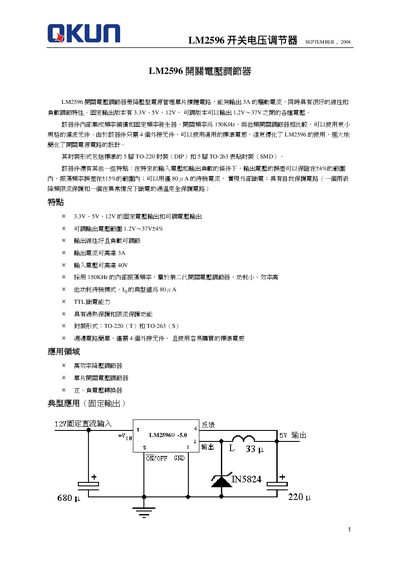
The LM2596 is a buck‑type switching regulator that can deliver up to 3 A of continuous output current. It operates from an input voltage range up to 40 V and offers fixed output versions (3.3 V, 5 V, 12 V) as well as an adjustable output from 1.2 V to 37 V.
The device is available in two surface‑mount packages, TO‑220 (T) and TO‑263 (S). It integrates internal frequency compensation and a 150 kHz switching oscillator, allowing the use of smaller external filter components and achieving high efficiency with low quiescent current. This manual is written in Chinese.
| Maximum Output Current | 3 A |
|---|---|
| Maximum Input Voltage | 40 V |
| Switching Frequency | 150 kHz |
| Package Types | TO‑220 (T) and TO‑263 (S) |
| Quiescent Current (Typical) | 80 µA |
The LM2596 can supply up to 3 A of continuous output current.
It operates with an input voltage up to 40 V.
The regulator is offered in TO‑220 (T) and TO‑263 (S) packages.
The device uses an internal oscillator set at 150 kHz.