
JDP2S01E is a UHF/VHF band transmit-receive antenna switch produced by Toshiba. It has the characteristics of a 2-terminal small periphery, a small series resistance (rs = 0.65 Ω), and a small capacity (CT = 0.65 pF).
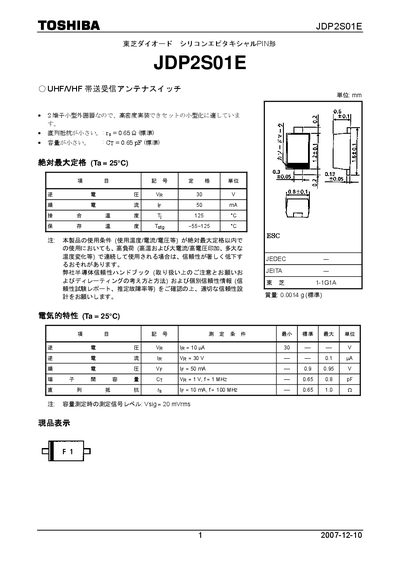
The JDP2S01E is a silicon epitaxial PIN diode offered by Toshiba. It is designed for high‑frequency UHF/VHTF band applications and features a low series resistance and small junction capacitance, making it suitable for high‑density mounting.
The datasheet lists absolute maximum ratings such as a 30 V reverse voltage and 50 mA forward current, as well as operating temperature limits from –55 °C to 125 °C. It also includes recommended handling procedures and cautions for use in high‑load or critical applications. This manual is written in Japanese.
| Reverse Voltage (VR) | 30 V |
|---|---|
| Forward Current (IF) | 50 mA |
| Operating Temperature Range | -55 °C to 125 °C |
| Junction Capacitance (Cj) | 0.65 pF |
| Series Resistance (rs) | 0.065 Ω |
| Reverse Leakage Current (IR) | 0.1 nA at 30 V |
| Forward Voltage (VF) | 0.9‑0.95 V at 50 mA |
| Weight | 0.0014 g |
The diode can withstand up to 30 V reverse voltage.
The device is rated for operation from –55 °C to 125 °C.
The typical junction capacitance is 0.65 pF.
The diode is rated for a forward current of 50 mA.