
TGS 816 is a sensor for detecting combustible gases. It has a wide range of combustible gas sensitivity, high sensitivity, long life and low cost.
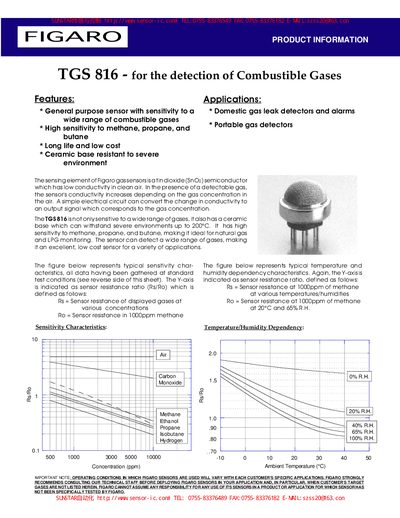
The TGS 816 is a general‑purpose semiconductor gas sensor that responds to a wide range of combustible gases, especially methane, propane and butane. Its tin dioxide (SnO₂) sensing element changes conductivity in the presence of target gases, allowing simple circuits to convert this change into an output signal. The sensor’s ceramic base can withstand temperatures up to 200 °C, making it suitable for domestic gas leak detectors, portable detectors and industrial safety applications.
Technical data include a measurement range of 500‑10 000 ppm, heater voltage of 5.0 ± 0.2 V (DC/AC), heater power consumption of about 835 mW, and a sensor resistance at 1000 ppm methane of 5 kΩ ~ 15 kΩ. Standard test conditions are 20 ± 2 °C and 65 ± 5 % RH, with a circuit voltage of 24 V (AC/DC). The sheet also provides dimensions, pin connections, and typical sensitivity curves for temperature and humidity.
| Measurement range | 500‑10 000 ppm |
|---|---|
| Heater voltage | 5.0 ± 0.2 V (DC/AC) |
| Heater power consumption | ≈ 835 mW |
| Circuit voltage | 24 V (AC/DC) |
| Sensor resistance at 1000 ppm methane | 5 kΩ ~ 15 kΩ |
| Sensitivity (Rs/Ro) | 0.55‑0.65 |
It is highly sensitive to methane, propane and butane, making it ideal for natural gas and LPG monitoring.
The heater operates at 5.0 ± 0.2 V (DC/AC).
The sensor can detect gas concentrations from 500 ppm up to 10 000 ppm.
The resistance is between 5 kΩ and 15 kΩ.