
Key facts
- Manuals
- 1
- Languages
- EN
- Last added
- 2023-10-31
Featured Hylleraas Centre manuals
Hylleraas Centre Photo Quality for Internet and Print User Guide
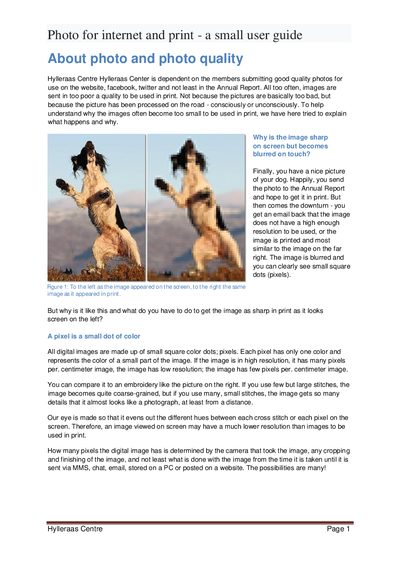
This short guide from the Hylleraas Centre explains why photos that look sharp on a screen can turn out blurred or pixelated when they are printed, and what members should do when submitting photos for the website, Facebook, Twitter and the Annual Report. It describes what a pixel is, what low and high resolution mean, and how resolution is measured in dpi/ppi.
The guide then shows how to check the file size of an image in Windows Explorer, compares JPEG with TIFF and other formats, and gives rules of thumb for how large a file should be for print (at least 1 MB, 2-3 MB for large printed images) versus for the web (50-200 KB). It closes with practical advice on copying photos from camera or phone to a PC without losing quality, sending them as email attachments or with FileSender, and keeping the original untouched.
Covers: Why images are sharp on screen but blurred in print · Pixels and resolution · Low and high resolution (dpi/ppi) · Checking image file size in the explorer · File formats: JPEG, TIFF, GIF · How big the picture must be
Latest Hylleraas Centre manuals
Hylleraas Centre Photo Quality for Internet and Print User Guide
Other 4 pages · 514 KB · ENShort Hylleraas Centre guide explaining why photos look sharp on screen but blurry in print, and how to keep image quality when sending photos.
Questions answered in Hylleraas Centre manuals
What resolution should an image have to be used in print?
It should have a resolution of 300 dpi, which equals 300 pixels for every 2.54 cm of the image.
From: Hylleraas Centre Photo Quality for Internet and Print User Guide
How large must a photo file be for print?
As a rule at least 1 MB in JPEG format, and 2-3 MB if the printed image is to be large.
From: Hylleraas Centre Photo Quality for Internet and Print User Guide