
Key facts
- Manuals
- 1
- Languages
- ZH
- Last added
- 2023-10-30
Featured Borax manuals
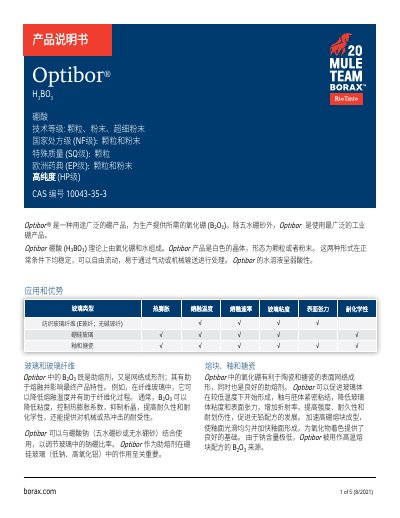
Borax Optibor H3BO3 Boric Acid Product Brochure
This is a five-page Borax product brochure for Optibor boric acid (H3BO3), CAS number 10043-35-3. It lists the available grades — technical grade (granular, powder, ultra-fine powder), NF grade (granular and powder), SQ grade (granular), EP grade (granular and powder) and high-purity HP grade — and describes the product as white crystals supplied as granules or powder that are stable under normal conditions, free-flowing and easy to handle by pneumatic or mechanical conveying. Aqueous solutions of Optibor are weakly acidic.
The brochure describes the uses of Optibor's B2O3 content in glass and fiberglass, frits, glazes and enamels, as a flame retardant for cellulosic materials, in metallurgy as a flux and boron source, as a corrosion inhibitor, in starch and casein adhesives, in personal care products, in nuclear applications as a boron-10 neutron absorber, and in chemical reactions such as nylon intermediates. It also gives physical and chemical data: theoretical composition (B2O3 56.30%, H2O 43.70%), molecular weight 61.83 g/mol, specific gravity 1.50, melting point 171°C, bulk density 55 lb/ft3, solubility in water and organic solvents, and pH at different concentrations. This manual is written in Chinese.
Covers: 玻璃和玻璃纤维 · 熔块、釉和搪瓷 · 阻燃性 · 冶金 · 防腐 · 粘合剂
Latest Borax manuals
Borax Optibor H3BO3 Boric Acid Product Brochure
Product Leaflet 5 pages · 1.2 MB · ZHBorax product brochure for Optibor boric acid (H3BO3): grades, applications in glass, ceramics, flame retardancy, metallurgy, plus physical and chemical data.
Questions answered in Borax manuals
What grades of Optibor boric acid are available?
Technical grade in granular, powder and ultra-fine powder; NF grade in granular and powder; SQ grade in granular; EP grade in granular and powder; and high-purity HP grade.
What happens when Optibor boric acid is heated above 100°C?
It gradually loses water and first becomes metaboric acid HBO2, which has three crystalline forms melting at 176°C, 201°C and 236°C.