
Key facts
- Manuals
- 1
- Languages
- EN
- Last added
- 2023-10-26
Featured University of Cincinnati manuals
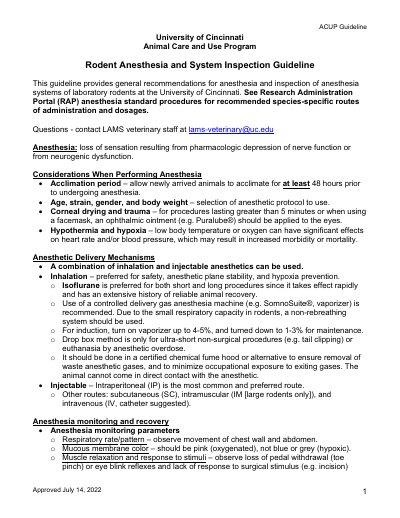
University of Cincinnati Rodent Anesthesia and System Inspection Guideline
This document outlines general recommendations for the anesthesia and inspection of anesthesia systems for laboratory rodents at the University of Cincinnati. It details considerations for performing anesthesia, including acclimation periods, animal characteristics, and specific handling for corneal drying and hypothermia. The text emphasizes the use of inhalation anesthesia, particularly isoflurane with a non-rebreathing system, and describes the drop box method for ultra-short procedures or euthanasia.
Covers: Considerations When Performing Anesthesia · Anesthetic Delivery Mechanisms · Anesthesia monitoring and recovery · Waste Anesthetic Gas Canister Use, Placement and Disposal · Anesthesia and Vaporizer Inspection Guidelines
Latest University of Cincinnati manuals
University of Cincinnati Rodent Anesthesia and System Inspection Guideline
Other 4 pages · 168 KB · ENThis guideline provides recommendations for rodent anesthesia and anesthesia system inspection at the University of Cincinnati, covering protocols…
Questions answered in University of Cincinnati manuals
What is the preferred anesthetic for both short and long procedures in rodents?
Isoflurane is preferred for both short and long procedures.
From: University of Cincinnati Rodent Anesthesia and System Inspection Guideline
What is the maximum weight increase allowed for a 50 gm waste anesthetic gas canister before it must be replaced?
The canister must not exceed 50 gm more than the initial baseline weight.
From: University of Cincinnati Rodent Anesthesia and System Inspection Guideline