
Yamamoto Electric Works EMRT1 square root extractor user manual: signal specs, DIN rail mounting, wiring, calibration and warranty.
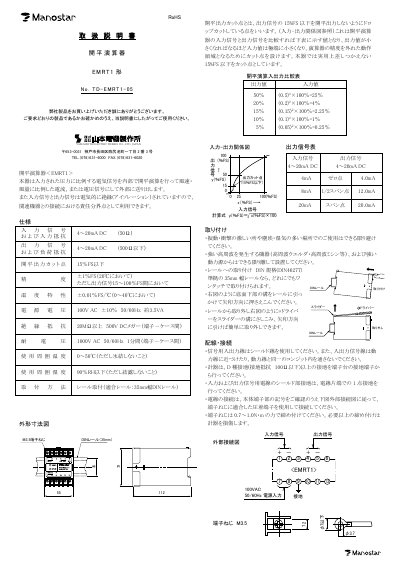
This Japanese user manual covers the EMRT1 square root extractor (開平演算器). The unit takes an input pressure signal and performs a square root calculation internally, sending out a current or voltage signal proportional to wind velocity or air volume; input and output signals are electrically isolated, so the unit can serve as a responsibility boundary when connecting related equipment.
The document lists input/output signal and load specifications, accuracy and temperature characteristics, power supply, insulation and withstand-voltage ratings, ambient conditions and DIN rail mounting, followed by installation precautions, wiring and grounding instructions, an external connection diagram, an input-output comparison table with the square root cut point, and notes on annual periodic calibration, product warranty and service scope. This manual is written in Japanese.
| Input signal and input resistance | 4–20 mA DC (50 Ω) |
|---|---|
| Output signal and load resistance | 4–20 mA DC (500 Ω or less) |
| Square root output cut point | 15 %FS or less |
| Temperature characteristics | ±0.01 %FS/°C (0–40 °C) |
| Power supply | 100 V AC ±10 %, 50/60 Hz, approx. 3.5 VA |
| Insulation resistance | 20 MΩ or more at 500 V DC (terminal to case) |
| Withstand voltage | 1000 V AC, 50/60 Hz, 1 minute (terminal to case) |
| Ambient operating humidity | 90 %RH or less (no condensation) |
| Mounting | Rail mounting, 35 mm wide DIN rail |
It performs a square root calculation internally on the input signal proportional to pressure and sends out a current or voltage signal proportional to wind velocity or air volume.
Yes. The input signal and output signal are electrically isolated, so the unit can be used as a responsibility boundary when connecting related equipment.
It mounts on any 35 mm wide rail conforming to DIN standards (DIN46277) with one-touch attachment, and can be removed with a minus screwdriver.
No special maintenance is needed if the unit is used correctly, but periodic calibration once a year is recommended.