
User manual for the StarNet GNSS1037 high‑precision GNSS receiver covering specifications, installation, interfaces and troubleshooting.
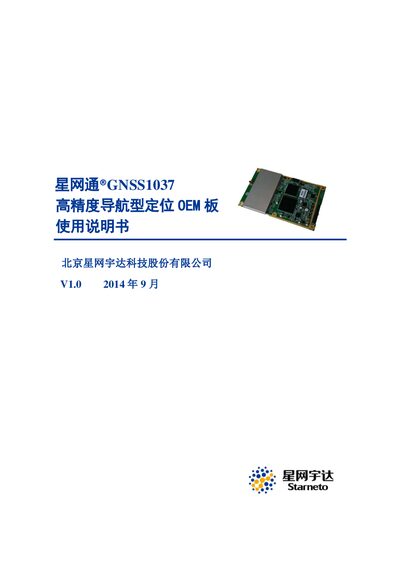
The StarNet GNSS1037 is a high‑precision, multi‑system GNSS receiver that supports BDS, GPS and GLONASS signals on seven frequencies. It is designed for applications such as reference stations, surveying, precision agriculture, and scientific research, offering RTK and E‑RTK positioning with baselines up to 100 km.
The manual provides a product overview, detailed technical parameters, installation instructions, hardware interface definitions, software protocol commands, safety precautions, usage and maintenance guidelines, and a troubleshooting appendix. It also includes example command sequences for setting up base‑station and rover configurations. This manual is written in Chinese.
| Pseudorange accuracy (GPS L1) | 10 cm |
|---|---|
| Carrier phase accuracy (GPS L1) | 0.5 mm |
| Power consumption (dual system) | 2 W |
| Operating temperature range | -40 °C to +75 °C |
| Physical dimensions | 60 mm × 100 mm × 11.6 mm |
Check that the antenna is not blocked and that the satellite view is adequate; verify that all cable connections are correct.
The receiver requires a DC input of +3.3 V to +3.6 V and consumes about 2 W in dual‑system mode.
It can receive signals from BDS (B1, B2, B3), GPS (L1, L2C/L2P) and GLONASS (L1, L2), covering seven frequencies in total.