
This datasheet describes the Winsensor MQ131, a semiconductor gas sensor using SnO2 for ozone concentration detection with high sensitivity and long life.
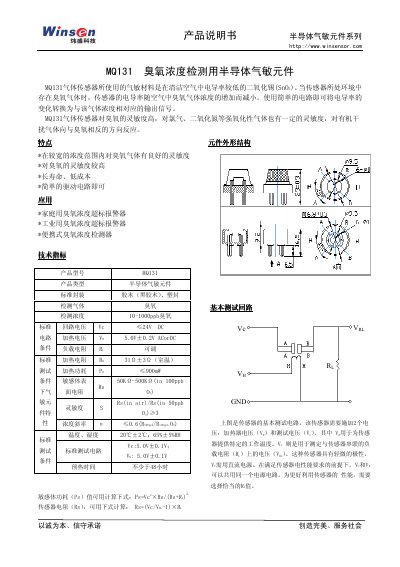
The Winsensor MQ131 is a semiconductor gas sensing element designed specifically for detecting ozone concentrations. It utilizes tin dioxide (SnO2) as its sensitive material, which exhibits lower electrical conductivity in clean air compared to when exposed to ozone. The sensor's resistance decreases as the concentration of ozone increases, allowing simple circuits to convert this change into an output signal proportional to the gas concentration. This manual is written in Chinese.
| Detection Gas | Ozone |
|---|---|
| Detection Concentration Range | 10-1000ppb Ozone |
| Test Voltage (Vc) | ≤24V DC |
| Heating Voltage (VH) | 5.0V±0.2V AC or DC |
| Standard Heating Resistance (RH) | 31Ω±3Ω (at room temperature) |
| Heating Power Consumption | ≤900mW |
| Sensitivity (Rs in air / Rs in 50ppb O3) | ≥3 |
It is primarily used for detecting ozone concentration in home, industrial, and portable alarm devices.
The sensor's electrical conductivity decreases as the concentration of ozone in the air increases.
The standard heating voltage (VH) should be 5.0V±0.2V AC or DC.