
A guide with theory, calculations, reference data and examples for designing electric heating systems using Watlow heaters and controllers.
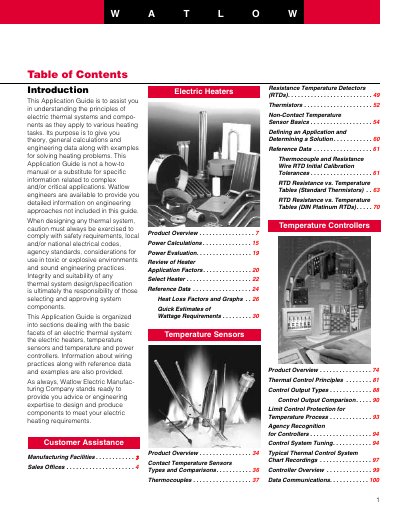
The Application Guide explains the principles of electric thermal systems and components, covering electric heaters, temperature sensors, and temperature‑and‑power controllers. It provides engineering data, wiring practices, and reference tables to help users calculate heater requirements and select appropriate products.
The document includes product overviews for band, cable, cartridge, cast‑in, circulation, ceramic‑fiber, multicell, and flexible heaters, as well as control and power‑controller information. It also lists worldwide sales offices, manufacturing facilities, and contact details for technical assistance.
| Maximum operating temperature of band heaters | 760°C (1400°F) |
|---|---|
| Typical maximum watt density of band heaters | 8.5 – 35.7 W/cm² |
| Maximum operating temperature of cable heaters | 650°C (1200°F) |
| Typical maximum watt density of cable heaters | 4.6 W/cm² (30 W/in2) |
| Maximum operating temperature of cartridge heaters | 760°C (1400°F) |
| Typical maximum watt density of cartridge heaters | 62 W/cm² (400 W/in2) |
Band heaters can operate up to 760°C (1400°F).
Flexible heaters typically achieve 1.7 to 17.0 W/cm².